+91 97699 99960 im@digantsharma.com

B2B Seat Belt Sourcing · India

Seat Belt Vendor Systems

Safety systems. Practical sourcing. Better vehicle protection.

Seat belts are the primary occupant restraint in almost every road vehicle on the planet — and the one component where a near-enough match is not good enough. We work as a vendor-side partner for buyers who need the right belt configuration, the right mounting arrangement and the right assembly for a defined application.

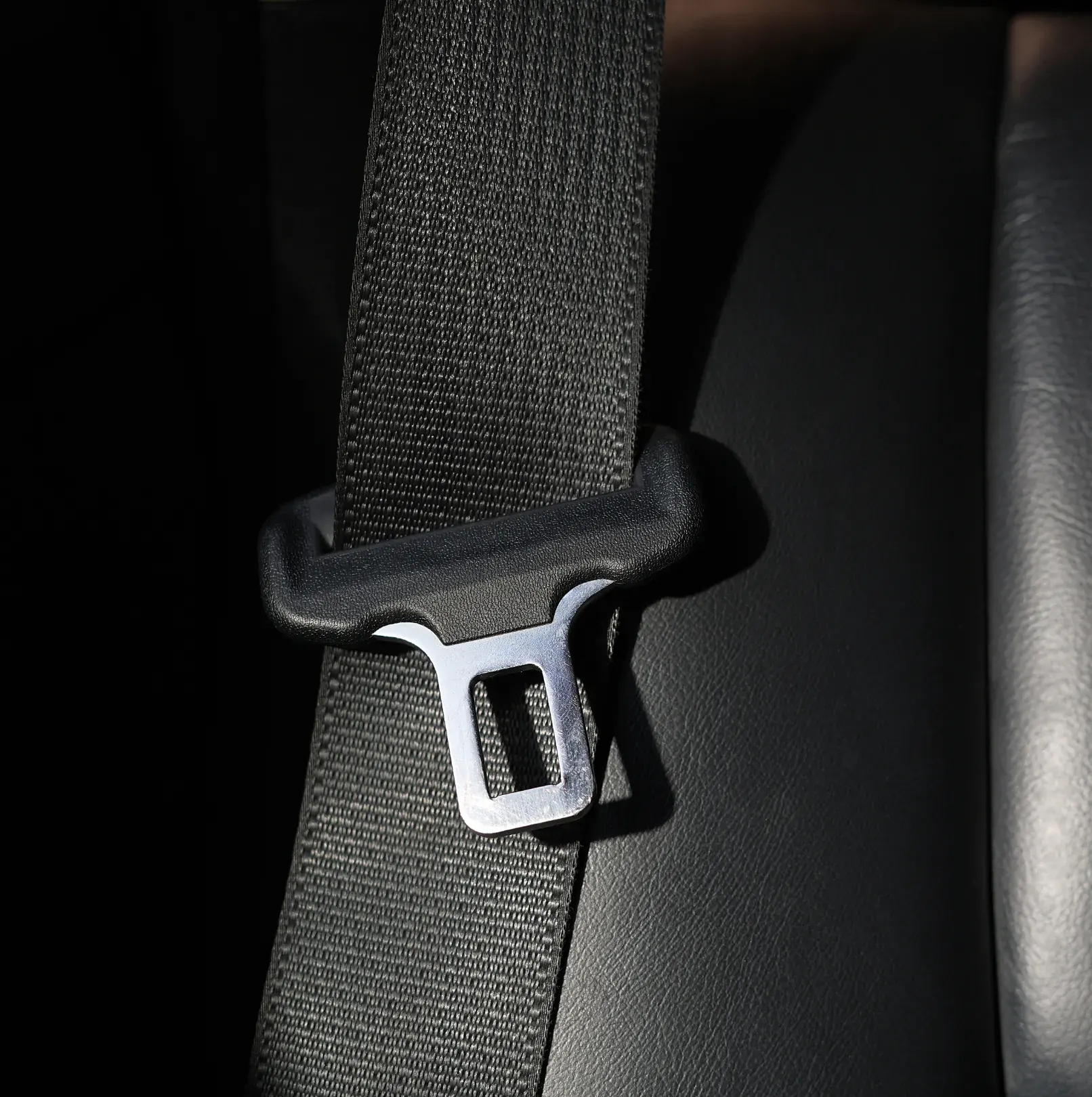
Close-up of a three-point automotive seat belt showing black polyester webbing threaded through a moulded shoulder guide with a polished steel latch plate

Ref / 3PTThree-point lap & diagonal geometry

Load pathWebbing → latch plate → anchorage

SelectionVehicle · Position · Mounting

01 / Scope

Passenger & Commercial

Belt requirements for cars, SUVs, vans, buses, trucks, utility and specialised vehicles.

02 / Configurations

Two-Point & Three-Point

Static and retractable assemblies, including ALR and ELR retractor behaviour.

03 / Purpose

Sourcing & Selection

Original-equipment style replacement, retrofit study and bulk requirement enquiries.

04 / Approach

Application-Led

Specification starts from the vehicle and the seating position — never from a part number alone.

01

Restraint fundamentals

Understanding vehicle
restraint systems

A seat belt does not simply hold an occupant in a seat. It manages the transfer of energy between a decelerating vehicle structure and the person travelling inside it.

In a sudden stop or an impact, an unrestrained occupant continues moving at the vehicle’s previous speed until something stops them — the steering wheel, the dashboard, a seat back, or another occupant. A correctly specified and correctly mounted belt intervenes far earlier. It couples the occupant to the vehicle structure so that deceleration is spread across the strongest parts of the body, across a longer period of time, and away from unprotected contact surfaces.

That is why seat belts are classed as safety-critical components rather than accessories. Every element in the chain matters: the webbing itself, the retractor that manages belt payout, the buckle and latch plate that form the release mechanism, and the anchorage points that tie the assembly into the vehicle body. A belt is only as capable as its weakest link — and in practice, the weakest link is usually a mismatch introduced during selection or installation, not a failure of the belt.

Understanding this changes how a seat belt should be bought. The question is rarely “which seat belt is best?” It is “which seat belt is correct for this vehicle, this seating position, this mounting arrangement and this operating environment?” That is the question this site is built to help answer.

How we approach it

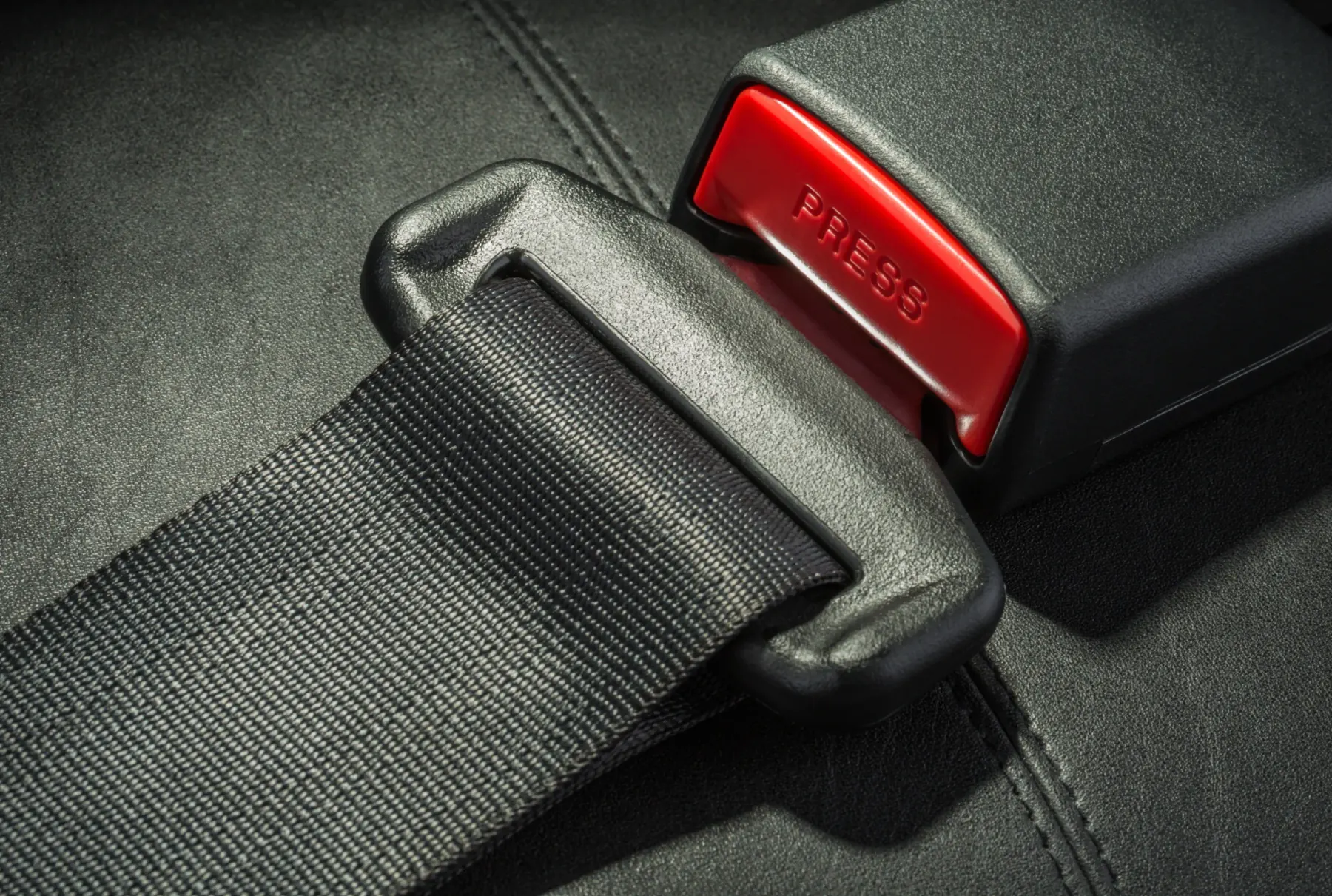
Detailed view of a fastened automotive seat belt with the latch plate seated inside a black buckle housing marked PRESS on a dark leather seat

Fig. 01 — Latch plate engaged in buckle housing3PT / ELR

02

Product categories

Seat belt solutions
overview

Seat belt assemblies are not interchangeable products with cosmetic differences. Each configuration exists because a particular seating position, vehicle architecture or duty cycle demanded it. These are the categories most enquiries fall into.

A.01

Three-point seat belts

The lap-and-diagonal arrangement used across almost all modern front and outboard rear seating positions. A single continuous length of webbing runs from a lower outboard anchorage, across the pelvis, up across the chest and shoulder, and back to an upper B-pillar or seat-mounted guide. The geometry loads the pelvis and rib cage — the structures best able to take it — and controls forward rotation of the upper body.

Lap + diagonalFront & outboard rearRetractor-fed

A.02

Two-point seat belts

A lap-only belt anchored either side of the seat. Still specified for certain centre-rear positions, folding seats, bench arrangements and a range of bus, coach and utility applications where a diagonal run is not structurally supportable.

Lap onlyCentre / bench

A.03

Retractable systems

A spring-loaded spool stores surplus webbing and keeps the belt in light contact with the occupant. Emergency-locking retractors (ELR) lock under vehicle or webbing deceleration; automatic-locking retractors (ALR) cinch to a fixed length, a behaviour often required for child restraint installation.

ELRALRAuto-stow

A.04

Static & non-retractable belts

Fixed-length webbing adjusted by hand through a slide adjuster. Simple, robust and serviceable — which is exactly why it persists in industrial vehicles, agricultural machinery, rear jump seats and specialised seating.

Manual adjustIndustrial

A.05

Commercial vehicle belts

Higher duty cycles, longer webbing runs, suspended-seat mounting and cab architectures that differ sharply from passenger cars. Fleet operators also weigh serviceability and repeatable specification across a mixed vehicle list.

Trucks & busesFleet supply

A.06

Replacement & retrofit requirements

Belts are replaced for worn or contaminated webbing, a sluggish or non-latching retractor, a damaged buckle, or after an event that loaded the assembly. Retrofit work — adding belts to positions that never had them, or upgrading a lap belt to a three-point — is a different exercise again, because it depends on whether compliant anchorage points exist or can be properly engineered into the structure.

Like-for-likeAnchorage studyProfessional fitment

A.07

Specialised applications

Wheelchair-accessible vehicles, ambulances, mobile workshops, mining and quarry plant, airport ground equipment, marine seating and modified passenger transport all place demands on a belt assembly that a standard catalogue entry does not describe. These requirements are handled as engineering conversations, not as a part lookup.

Accessible transportOff-highwayCustom length

Full solutions breakdown

A driver and a rear-seat passenger both wearing fastened three-point seat belts during a journey

One component. Very different duty cycles.

A belt in a private car may be used twice a day. The same nominal belt in a shared commercial vehicle may cycle forty times a day, every day, for years.

03

Application map

Where seat belt
systems are used

The same three-point geometry appears across wildly different vehicles — but the assembly around it changes with the structure, the seat, the occupant and the operating environment.

  • R.01

    Passenger vehicles

    Cars · Hatchbacks · Sedans · SUVs

    Densely packaged cabins with belt hardware integrated into B-pillars, C-pillars, sills and seat frames. Retractor behaviour, height-adjuster travel and webbing length are matched to a specific body shell, which is why belts rarely transfer cleanly between models even within the same manufacturer.

    • Front outboard, rear outboard and rear centre positions each behave differently
    • Upper anchorage height affects how the diagonal sits across the shoulder
  • R.02

    Commercial & goods vehicles

    LCV · Trucks · Tippers · Tractor units

    Cab structures, air-suspended seats and long webbing runs change the specification substantially. Where the seat itself moves relative to the cab, belt anchorages are often seat-integrated so that geometry stays constant regardless of suspension travel.

    • Higher daily cycle counts increase wear on webbing and retractor mechanisms
    • Fleet buyers usually need specification repeatability across mixed vehicle lists
  • R.03

    Buses & coaches

    Staff transport · Intercity · Tourist

    Seat-integrated belts are common because the passenger seat frame — not the body side — carries the anchorage load. That makes the seat structure part of the restraint system, and it means belt selection has to follow the approved seat, not just the vehicle.

    • Two-point and three-point configurations both appear, depending on seat approval
    • Volume replacement programmes need consistent parts across a whole saloon
  • R.04

    School & institutional transport

    School buses · Campus · Staff shuttle

    Operators in this segment tend to work to internal safety policy as well as statutory requirements, and they replace on schedule rather than on failure. Ease of inspection, clear condition assessment and reliable availability of matching parts all matter more here than in most other segments.

    • Regular visual inspection routines drive predictable replacement demand
    • Consistency across a fleet simplifies driver checks and maintenance records
  • R.05

    Industrial & off-highway vehicles

    Forklifts · Loaders · Plant · Agriculture

    Dust, moisture, chemical exposure and vibration dominate here, and the restraint is often as much about keeping the operator inside a protective structure during a tip-over as it is about frontal impact. Static lap belts with heavy-duty adjusters are common because they tolerate contamination and are simple to inspect.

    • Environmental contamination is the primary driver of webbing degradation
    • Simple mechanisms are preferred for field serviceability
  • R.06

    Utility & specialised mobility

    Ambulances · WAV · Site vehicles · Conversions

    Converted and purpose-built vehicles frequently need belt assemblies in positions the base vehicle never had. Every one of these is an anchorage question first: the belt can only be as strong as the structure it is attached to, and that structure has to be assessed by someone qualified to do it.

    • Non-standard webbing lengths and anchorage angles are the norm, not the exception
    • Requirements are defined by the converted layout, not the donor vehicle

Full applications guide

04

Selection sequence

How to select the
right seat belt

Work through these in order. Each step narrows the field, and skipping one is the most common reason a belt arrives, fits physically, and still isn’t right.

  1. Identify the vehicle

    Make, model, generation, body style, model year and market. Belt hardware changes across facelifts and across regional variants of the same nameplate, so a model name alone is not enough to specify from.

    • Record the VIN where it is available
    • Note whether the vehicle has been converted or rebodied
  2. Determine the seating position

    Front driver, front passenger, rear outboard left, rear outboard right, rear centre, third row, or a jump seat. Handing matters: a left-hand belt is not a mirrored right-hand belt in most assemblies, because buckle stalk length and webbing exit angle differ.

    • Confirm left- or right-hand drive layout
    • Count from the front and state the row explicitly
  3. Understand the mounting arrangement

    Establish whether the assembly anchors to the body shell, to the seat frame, or to a combination of both. Note the bolt sizes and thread forms at each anchorage, and the angle at which the belt leaves each point. This is the single most decisive factor in whether a given assembly can be used at all.

    • Photograph each anchorage point before ordering
    • Record whether the upper anchorage is height-adjustable
  4. Check the belt configuration

    Two-point or three-point. Retractable or static. If retractable, whether the retractor is emergency-locking, automatic-locking, or switchable between the two. A switchable retractor matters if child restraints will be installed at that position.

    • Note buckle stalk type: rigid stalk, flexible cable or webbing stalk
    • Note the latch plate profile and whether it is free-sliding or fixed
  5. Review compatibility

    Compare webbing length, stalk length, retractor body dimensions and connector geometry against the space actually available. Also confirm the buckle and latch plate are a matched pair — buckle and tongue geometry is not universal, and a tongue that enters a buckle is not proof that the pair is designed to work together.

    • Check clearance for the retractor behind the trim panel
    • Confirm any electrical connector for a buckle-status switch or pretensioner
  6. Confirm application needs

    Finally, sanity-check the choice against the real duty cycle: how often the belt is used, who uses it, what environment it operates in, and what the applicable vehicle requirements are for that position. Then confirm the fitment plan — safety-critical installation should be carried out by a qualified professional.

    • Match the specification to actual daily usage, not nominal usage
    • Plan inspection intervals at the same time you plan the purchase
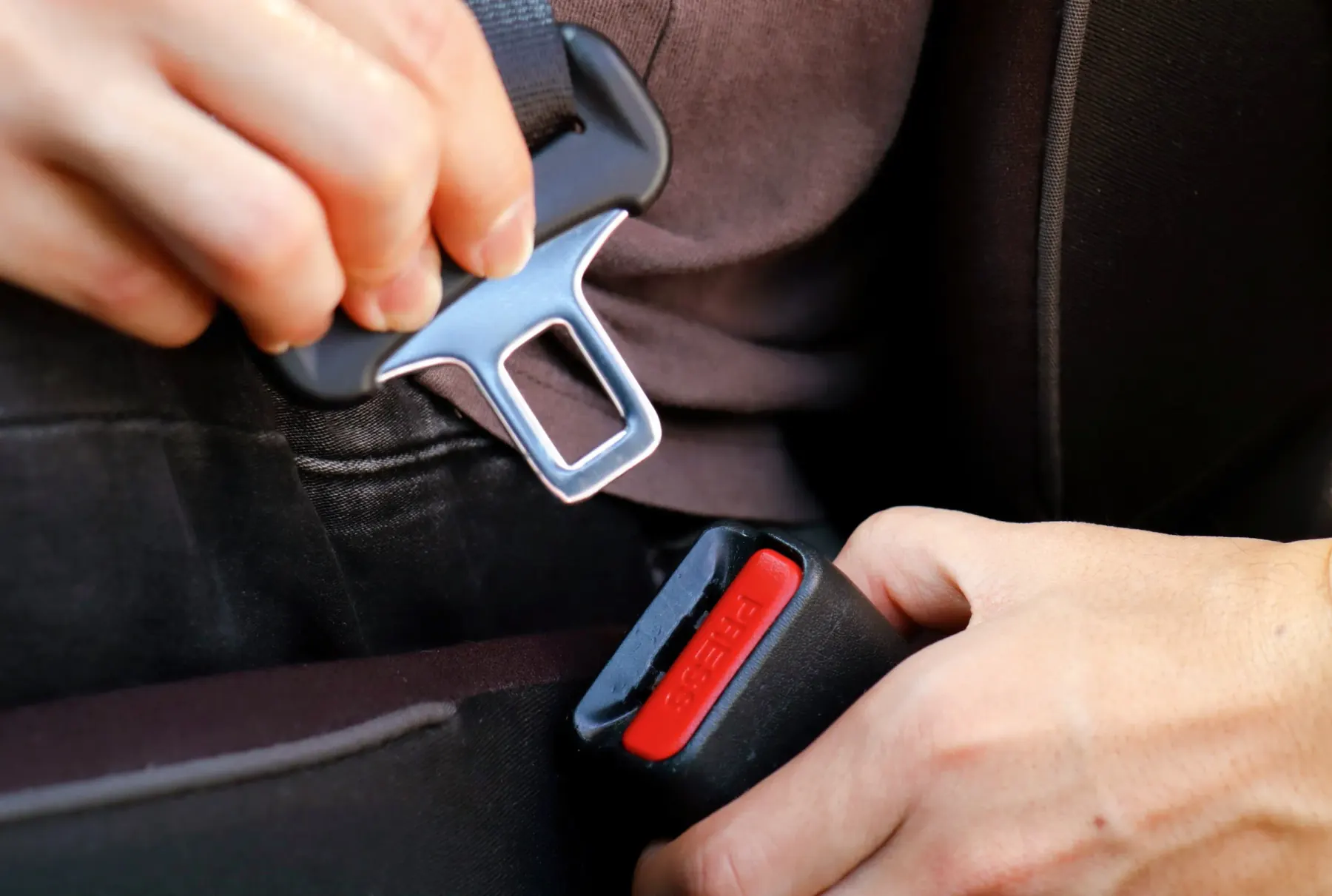
Two hands guiding a metal seat belt latch plate towards a black buckle receptacle with a red release button inside a vehicle

Fig. 02 — Latch plate and buckle must be a matched pairRef / SEL-05

Before you order

If any step above cannot be answered with confidence, that is the point to ask rather than to estimate. Send us the vehicle details, the seating position and photographs of the existing anchorages and we will work through the specification with you.

Send vehicle details

05

Assembly breakdown

Components of a
seat belt system

A seat belt is an assembly of parts that each have to do their job for the system to work. Knowing what they are makes it far easier to describe a fault, specify a replacement or inspect a belt properly.

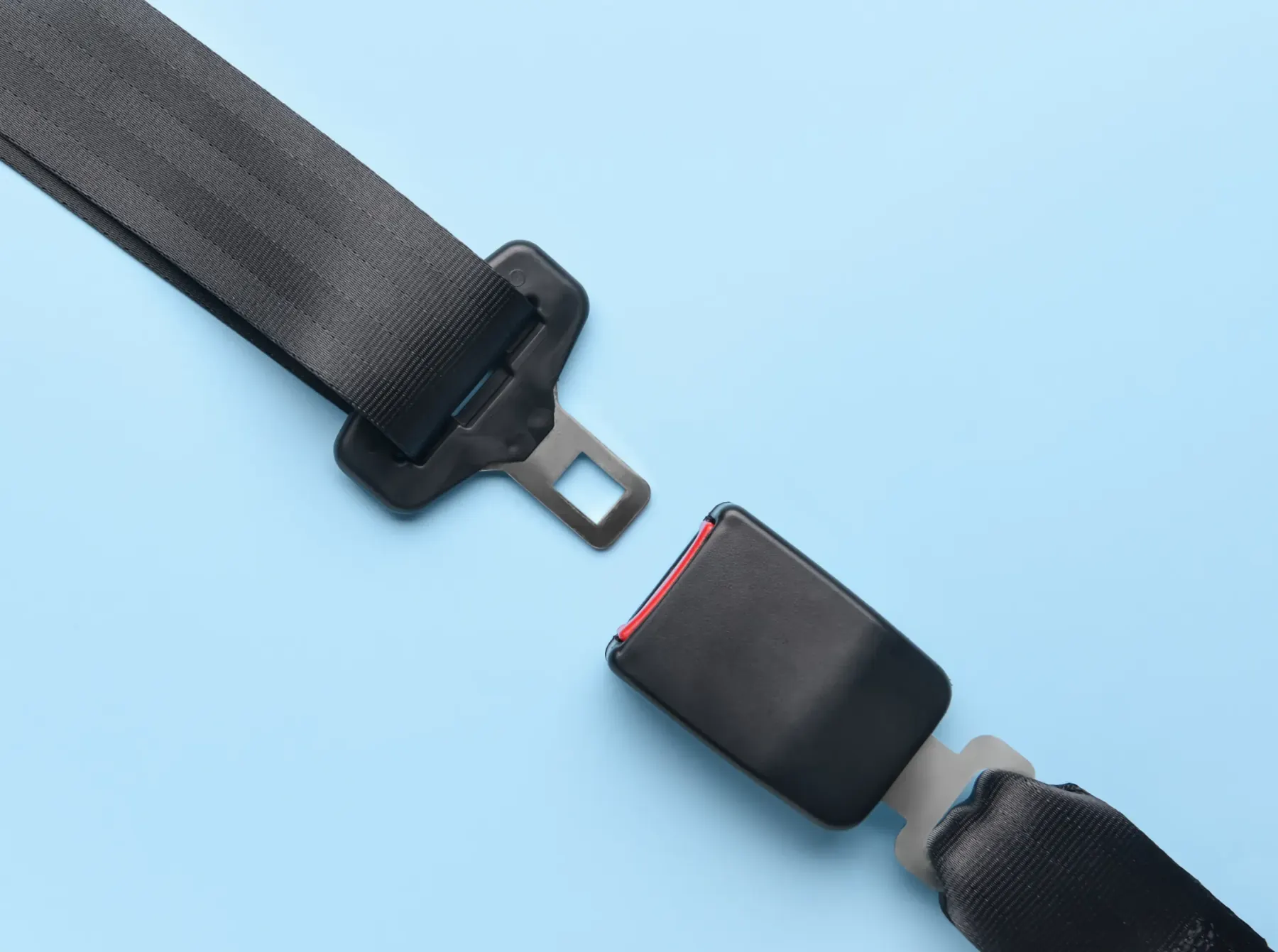
A complete seat belt assembly laid flat on a pale blue background, showing the webbing, the moulded latch plate with its metal tongue, and the separate buckle receptacle 1Webbing 4Tongue / latch plate 3Buckle 5Mounting end
Fig. 03 — Belt assembly, principal visible componentsRef / CMP
  • Webbing

    The woven strap itself, normally high-tenacity polyester, engineered to a defined width and a controlled amount of stretch. That controlled elongation is deliberate: it lengthens the deceleration event and reduces peak load on the occupant. Webbing is also the most exposed component and the one where wear shows first.

  • Retractor

    The spring-loaded spool that stores webbing and takes up slack. Emergency-locking retractors lock the spool when the vehicle decelerates sharply or the webbing is pulled quickly; automatic-locking retractors cinch to a set length and will not pay out again until fully rewound. It usually sits inside the pillar or seat structure, out of sight.

  • Buckle

    The receptacle that captures and holds the tongue, with a release button sized to be operated quickly and deliberately. It sits on a rigid stalk, a flexible cable or a short webbing stalk, and may carry an electrical switch that reports belt status to the vehicle.

  • Tongue / latch plate

    The metal plate that enters the buckle. On a three-point belt it usually slides freely along the webbing, which is what allows one continuous strap to serve as both the lap and the diagonal section. Its profile is matched to a specific buckle family.

  • Mounting points & anchorages

    The bolted or welded attachments that tie the assembly into the vehicle. They carry the entire restraint load into the structure, which is why their condition, thread integrity, torque and the strength of the surrounding metal are as important as the belt itself.

  • Adjusters

    Slide adjusters on static belts set the working length by hand. Height adjusters on the upper anchorage of a three-point belt move the D-ring up or down so the diagonal crosses the middle of the shoulder rather than the neck or the arm.

  • Guides & end fittings

    D-rings, pillar loops, moulded shoulder guides, sewn loops and stamped anchor plates that route the webbing and terminate it. They set the angles the belt works at, and a worn or wrongly angled guide will change how the whole assembly behaves.

Items 2, 6 and 7 sit behind trim or inside the seat structure and are not visible in the view above.

06

Consequence of getting it wrong

Why proper
selection matters

A belt that fits the holes is not the same as a belt that fits the vehicle.

Selection principle — Seat Belt Vendor

Occupant restraint

Belt geometry decides where load lands on the body. If the diagonal sits across the neck or slides off the shoulder, or the lap section rides up onto the abdomen instead of sitting low across the pelvis, the belt is no longer loading the structures it was designed to load. Geometry follows from anchorage positions and webbing length — both of which are selection decisions.

Vehicle compatibility

Retractor housings, stalk lengths and connector types are packaged to a specific vehicle. An assembly that is physically forced into a space it was not designed for can bind, foul on trim, or place the retractor at an angle where its locking mechanism does not behave as intended.

Installation considerations

Correct bolt grade, correct torque, correct spacer and washer stack, correct orientation, and sound metal at every anchorage. These are not finishing details; they are the load path. Installation of safety-critical restraint components should be carried out by a qualified professional working to the applicable vehicle requirements.

Product condition

Cuts, fraying, chemical staining, heat glazing, UV chalking, a retractor that hesitates to lock or refuses to retract, and a buckle that does not release cleanly are all reasons to take an assembly out of service. Condition should be assessed on the actual part, not assumed from age alone.

Appropriate application

A belt specified for an occasional-use rear seat is not the same proposition as one cycling dozens of times a day in a shared commercial vehicle exposed to dust and moisture. Matching the specification to the real duty cycle is what makes a belt last its intended service life.

Read the quality & safety notes

07

Buyer knowledge

Things worth knowing
before you buy

Practical points that come up repeatedly in enquiries, collected here so they are useful before an order is placed rather than after.

K.01

Handing is not cosmetic

Left-hand and right-hand assemblies differ in stalk length, webbing exit angle and retractor orientation. Ordering the opposite hand because it looks similar produces a belt that sits at the wrong angle even when every bolt lines up.

K.02

Buckle and tongue are a pair

Latch plate profiles vary between manufacturers and even between platforms. A tongue that physically enters an unrelated buckle may not be retained the way the pair was designed to retain. Always specify buckle and tongue together.

K.03

Webbing length is a specification

Too short and the belt cannot be fastened comfortably by a larger occupant or over winter clothing. Too long and the retractor may not fully stow the surplus, leaving webbing to trail and abrade. Measure rather than estimate.

K.04

ALR matters for child seats

Many child restraints are installed using the vehicle belt and rely on an automatic-locking mode to hold the belt at a fixed length. If a position will carry a child restraint, the retractor behaviour needs to be confirmed before purchase.

K.05

Anchorages come first in retrofits

Adding a belt where none existed is an anchorage engineering task before it is a parts task. Whether compliant anchorage points exist, or can be properly created in the structure, determines what — if anything — can be fitted.

K.06

Photographs shorten everything

Clear photographs of the existing belt, both anchorage points, the buckle stalk and any labels on the assembly resolve more specification questions in one message than a long written description usually can.

08

Common questions

Frequently asked

A two-point belt is a lap belt: it has two anchorage points and restrains the pelvis only. A three-point belt adds an upper anchorage, so a single length of webbing forms both a lap section and a diagonal chest section. The third point is what controls forward rotation of the upper body, which is why three-point belts are standard at almost all modern seating positions where the structure supports an upper anchorage.

No. Anchorage positions and thread forms, webbing length, stalk length, retractor packaging space and buckle-to-tongue matching are all vehicle-specific. A belt that bolts up is not automatically a belt that works correctly. Selection should always start from the vehicle, the seating position and the mounting arrangement.

One where surplus webbing is stored on a spring-loaded spool called a retractor. The belt stays in light contact with the occupant and stows itself when released. Most retractors are emergency-locking: they allow normal movement but lock the spool under sharp vehicle deceleration or a fast pull on the webbing.

No. Cuts, fraying, chemical staining, heat glazing and UV chalking all reduce the load the webbing can carry, and the loss is not proportional to how bad the damage looks. Damaged webbing is a reason to take the assembly out of service and have it assessed or replaced, not a cosmetic issue to monitor.

Yes. Seat belts are safety-critical restraint components. Anchorage condition, bolt grade, torque, spacer arrangement and belt routing all affect whether the assembly can carry load as intended, and several of these cannot be verified by eye after the fact. Installation and any safety-critical modification should be carried out by a qualified professional in line with the applicable vehicle requirements.

All questions & answers

09 — Start a conversation

Tell us the vehicle.
We’ll work back to the specification.

Product requirements, application questions, bulk and fleet enquiries, or a straightforward “is this the right belt for this position?” — all are welcome. Send the vehicle details, the seating position and photographs of the existing anchorages, and we will respond with a considered answer rather than a catalogue link.