Eight categories, each explained from the ground up: what it is, where it is used, how it
is built, what to check before selecting it, and the questions worth asking before an
order is placed.
Categories describe intent, not interchangeability
Two assemblies can share a category name and still be entirely unsuitable for each
other’s position. Treat the category as the starting point of a specification, and
the vehicle, seating position and mounting arrangement as the parts that finish it.
Installation and safety-critical work
Nothing on this page is an installation instruction. Seat belts are safety-critical
restraint components whose performance depends on anchorage integrity, fastener
specification, torque and belt routing. Installation, replacement and any safety-critical
modification should be carried out in accordance with the applicable vehicle requirements
and, where necessary, by a suitably qualified professional.
SBS / 01 — Lap & diagonal
Three-point seat belts
The configuration that defines modern occupant restraint: one continuous length of
webbing anchored at three points, restraining the pelvis and the upper torso from a
single assembly.
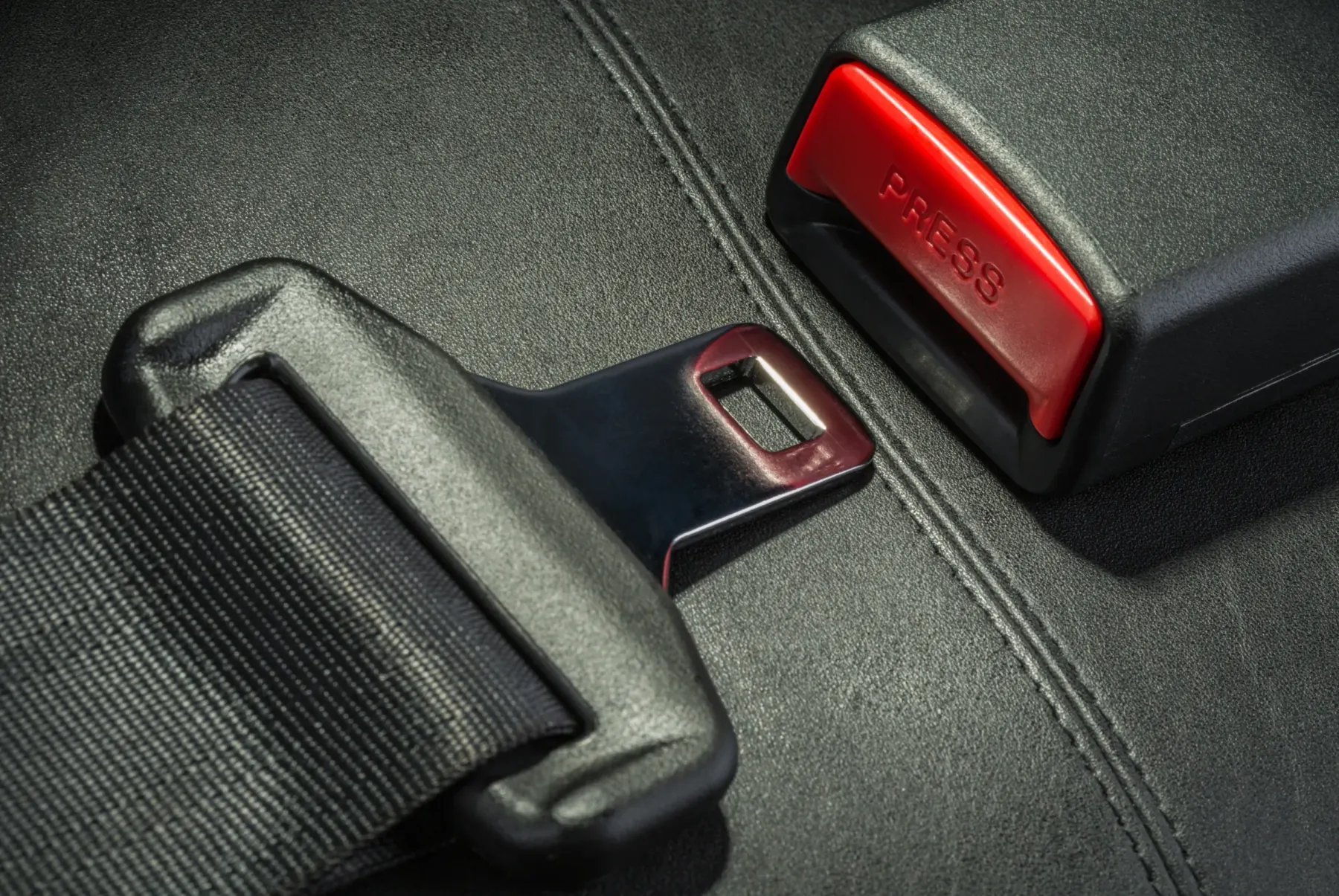
Latch plate and matched buckle receptacleRef / 3PT
What it is
A belt anchored at a lower outboard point, an upper point above and behind the
shoulder, and a buckle on the inboard side. A free-sliding latch plate divides the
single webbing run into a lap section and a diagonal section, so the two work
together as one system rather than as two independent belts.
Typical application
Front driver and passenger positions, rear outboard positions, and increasingly rear
centre positions where the roof or seat structure can carry an upper anchorage. Also
widely used in commercial cabs, coach seating and converted vehicles wherever a third
anchorage is structurally supportable.
Basic construction
High-tenacity woven webbing, a retractor at one end, an upper guide or D-ring,
a sliding latch plate, a buckle on a rigid or flexible stalk, and stamped anchor
fittings at each termination. Many modern assemblies also integrate a pretensioner
and a load limiter within the retractor.
Selection considerations
Handing of the seating position — left and right assemblies are not mirrored
Upper anchorage height and whether a height adjuster is fitted
Webbing working length against occupant size and clothing
Retractor type: emergency-locking, automatic-locking or switchable
Compatibility
Buckle and latch plate must be a matched, designed pair
Retractor body must fit the available cavity without being forced or angled
Anchor bolt sizes and thread forms must match the vehicle anchorages
Any buckle-status switch or pretensioner connector must match the harness
Installation awareness
Anchorage metal and threads must be sound before anything is fitted
Webbing must run without twist through every guide
Fastener grade and torque are specification, not preference
Pyrotechnic pretensioners require correct handling and are professional-only work
Ask before you buy
Which exact seating position, and which hand — left or right?
Is the upper anchorage on the pillar, the roof rail or the seat frame?
Is a height adjuster fitted at that position on this variant?
Does the retractor need an automatic-locking mode for a child restraint?
Are the supplied buckle and latch plate a matched pair from the same family?
SBS / 02 — Lap only
Two-point seat belts
The lap belt. Two anchorages, one webbing run across the pelvis. Simple, compact, and
still the correct answer wherever the structure will not support a third point.
What it is
A belt anchored either side of the seat that restrains the pelvis only. It does not
control forward rotation of the upper body, which is why it is specified where a
three-point layout is not structurally possible rather than as a preference.
Typical application
Rear centre positions on older vehicles, bench seats, folding and jump seats, some
bus and coach seating, industrial vehicle operator seats and a wide range of utility
and off-highway machines where a rollover protective structure works with the lap
belt to keep the operator within the protected zone.
Basic construction
Webbing terminated in anchor plates at both ends, a buckle at one side and a latch
plate at the other, and either a slide adjuster for manual length setting or a
compact retractor. Fewer parts than a three-point belt, and correspondingly fewer
things to go out of specification.
Selection considerations
Anchorage spacing and the angle the belt leaves each anchor plate
Whether the belt is static or retractor-fed
Adjuster type and how easily it can be operated with gloves
Overall length across the widest expected occupant
Compatibility
Anchor plate hole diameter and bolt grade must match the mounting
Buckle stalk length must suit the seat cushion depth
Some seat designs require a specific anchor plate angle to sit correctly
Latch plate profile must match the buckle family supplied
Installation awareness
The lap section must sit low across the pelvis, not across the abdomen
Anchor plates must be free to pivot and must not be clamped rigid
Correct washer and spacer stack matters at every anchorage
Fitment should follow the applicable vehicle requirements
Ask before you buy
What is the distance between the two existing anchorage points?
Is the anchorage on the seat frame, the floor pan or a crossmember?
Is a retractor wanted, or is a hand-adjusted static belt preferred here?
What is the widest occupant this position needs to accommodate?
Is an upper anchorage available — in which case should this be a three-point?
SBS / 03 — Spool-managed
Retractable seat belt systems
The mechanism that made belts convenient enough to be worn. A spring-loaded spool stores
surplus webbing, keeps the belt in light contact with the occupant, and locks when it
needs to.
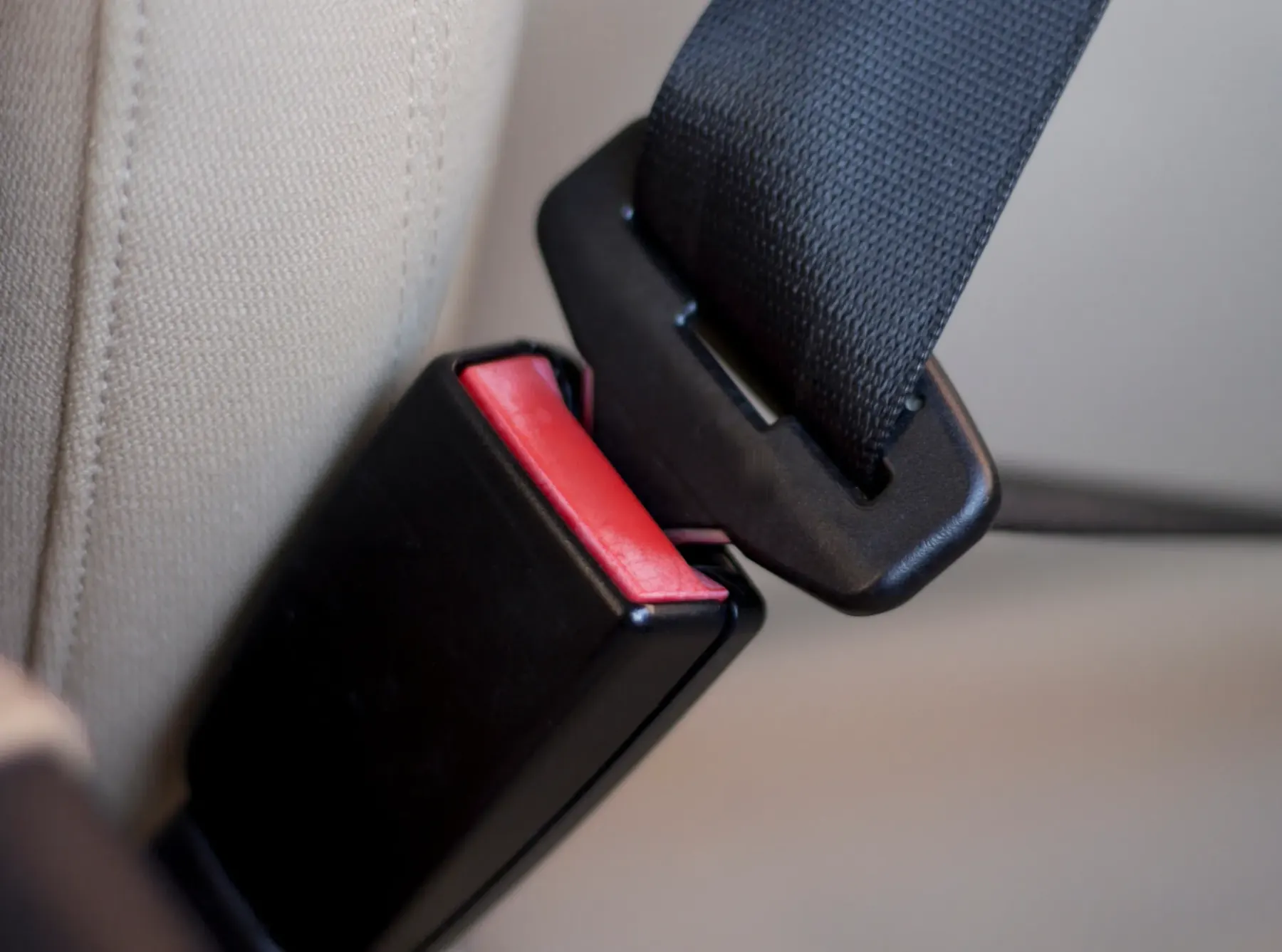
Retractor-fed webbing entering a buckle assemblyRef / RTR
What it is
A belt whose length is managed automatically by a retractor. Emergency-locking
retractors (ELR) permit normal movement and lock the spool when the vehicle
decelerates sharply or the webbing is pulled quickly. Automatic-locking retractors
(ALR) cinch to a fixed length once the belt is pulled out and will not extend again
until fully rewound.
Typical application
Effectively every modern passenger seating position, most commercial vehicle cab
seats, and any application where the belt must be convenient enough to be used
consistently. Switchable ELR/ALR retractors are standard at positions expected to
carry child restraints.
Basic construction
A spool wound with webbing, a clock spring providing retraction torque, and a
locking mechanism driven by an inertial sensor, a webbing-speed sensor, or both.
Many units add a pretensioner that removes slack at the start of an impact event and
a load limiter that allows controlled webbing payout above a threshold force.
Selection considerations
ELR, ALR or switchable — confirm which the position needs
Retractor body dimensions against the available cavity
Mounting orientation, which affects inertial sensing behaviour
Whether a pretensioner or load limiter is part of the original specification
Compatibility
Webbing exit angle from the retractor must match the intended routing
Electrical connectors must match the vehicle harness where fitted
Spool capacity must suit the working length required
Trim clearance behind the pillar or seat back must be verified
Installation awareness
A retractor mounted off its designed axis may not lock as intended
Webbing must not rub on trim edges as it enters the spool
Pyrotechnic pretensioners are hazardous if mishandled — professional work only
Function should be verified after fitting, following the vehicle documentation
Ask before you buy
Does the belt lock when pulled sharply and lock under vehicle deceleration?
Is an automatic-locking mode required at this position?
Does the original assembly include a pretensioner or load limiter?
What are the retractor’s external dimensions and mounting orientation?
Is there an electrical connector, and does it match the vehicle side?
SBS / 04 — Fixed length
Static seat belts
No retractor. The occupant sets the length by hand through a slide adjuster, and it stays
there. Unfashionable, extremely robust, and often the better engineering answer in harsh
environments.
What it is
A fixed-length belt whose working length is set manually. Because there is no spool,
no clock spring and no inertial mechanism, there is very little that dust, moisture
or vibration can degrade — and very little that needs specialist diagnosis when
something does go wrong.
Typical application
Forklifts, loaders, excavators, agricultural machinery, mining and quarry plant,
airport ground support equipment, rear jump seats, marine and workboat seating, and
specialised or converted seating positions where reliability under contamination
matters more than convenience.
Basic construction
Webbing, two anchor plates, a buckle and latch plate, and a slide adjuster —
typically a stamped or cast metal loop that grips the webbing under load and releases
when the webbing is presented at an angle. Heavy-duty variants use wider webbing and
larger adjusters that can be operated with gloved hands.
Selection considerations
Total webbing length and the adjustment range needed
Adjuster style and whether it can be worked with gloves
Webbing width and any contamination or abrasion exposure
Buckle style — push-button, lift-lever or automotive-type
Compatibility
Anchor plate geometry must match the machine mounting brackets
Bolt diameter and grade must match the anchorage provision
Some machines require a specific belt-fitted switch for interlock functions
Replacement lengths should be measured, not assumed from the previous belt
Installation awareness
Adjusters must be free to grip — contamination defeats them silently
Webbing must not be routed over a sharp bracket edge
Anchorage brackets should be checked for corrosion before refitting
Follow the machine manufacturer’s requirements for restraint fitment
Ask before you buy
What overall length is required, measured on the machine?
What is the environment — dust, water, chemicals, heat?
Is the belt tied into a seat-occupancy or interlock switch?
What buckle style do the operators already use across the fleet?
How often will the belt be inspected, and by whom?
SBS / 05 — Cars, SUVs, vans
Passenger vehicle applications
Densely packaged, highly variant-specific, and the category where a small mismatch is
easiest to miss because everything physically bolts up.
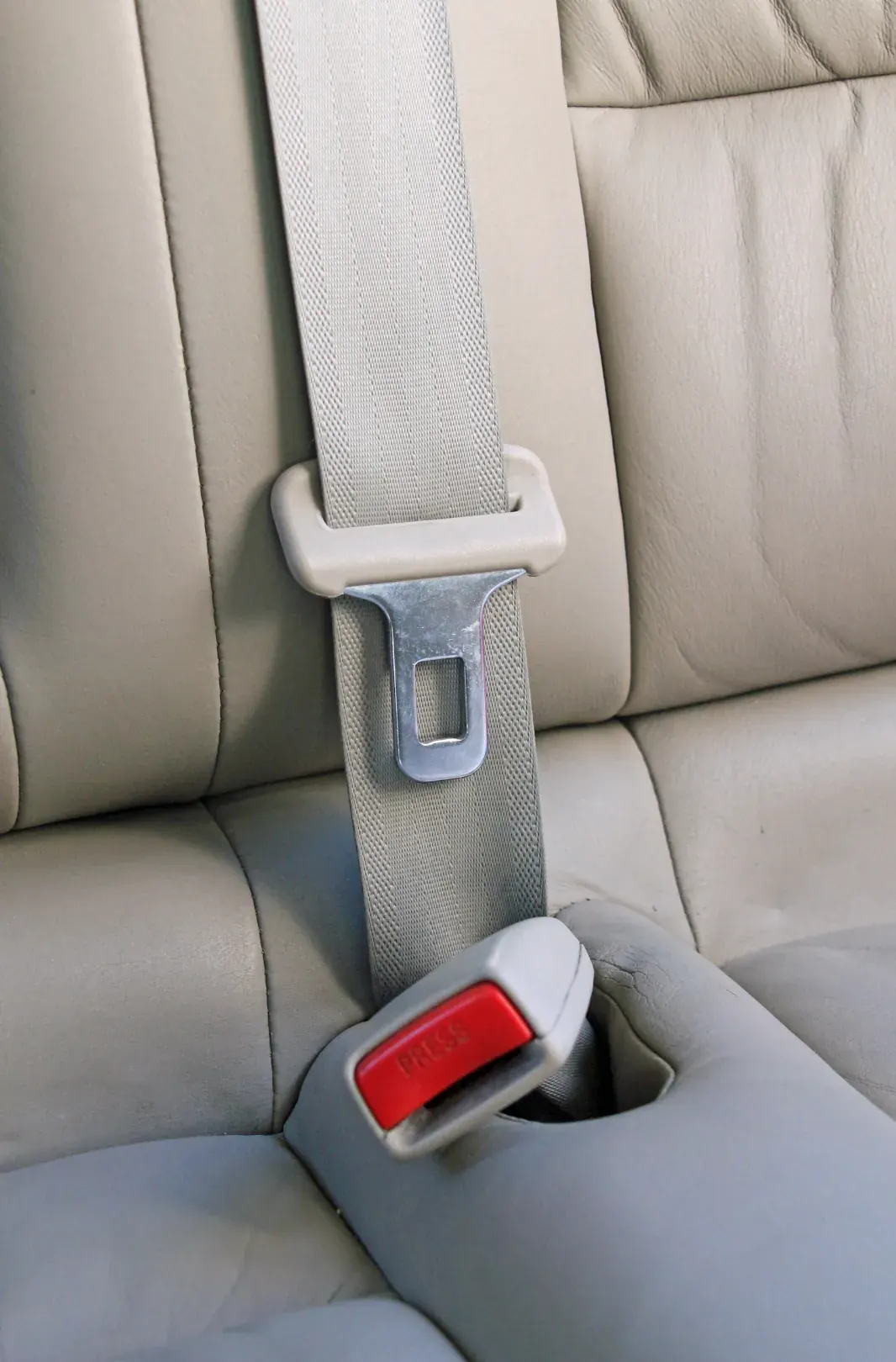
Rear bench position with guide, latch plate and buckleRef / PAX
What it is
Belt hardware engineered around a specific body shell. Retractors live inside
B-pillars, C-pillars, seat backs or side trim; guides are moulded into pillar covers;
buckle stalks are shaped to clear the seat cushion and the console. Almost every
dimension is a consequence of the vehicle’s packaging.
Typical application
Hatchbacks, sedans, estates, SUVs, MPVs and passenger vans across front, second-row
and third-row positions — including the increasingly common rear centre
three-point belt fed from a roof-mounted or seat-back-mounted retractor.
Basic construction
Standard three-point architecture with model-specific retractor housings, trim
interfaces and connector types. Front positions frequently carry pretensioners and
load limiters, and often a buckle-mounted switch that reports belt status to the
vehicle’s warning system.
Selection considerations
Model, generation, facelift, body style, model year and market
Exact row and handing of the position
Trim level, which can change guide and adjuster hardware
Whether the original assembly included a pretensioner
Compatibility
Regional variants of the same nameplate often differ in belt hardware
Colour and finish matter for visible components in a customer vehicle
Connector type and pin count must match the vehicle harness
Third-row and folding-seat positions may use unique stalk geometry
Installation awareness
Trim removal can disturb airbag and pretensioner wiring — take care
Belt warning and airbag systems may need a diagnostic reset after work
Anchorage bolts often use a specific shoulder or spacer arrangement
Have the work carried out by a qualified professional
Ask before you buy
What is the vehicle identification number?
Which row, which side, and is the vehicle left- or right-hand drive?
Does the existing assembly carry a pretensioner or an electrical connector?
Is a colour or finish match required for a visible component?
Is the vehicle standard, or has it been converted or rebodied?
SBS / 06 — Trucks, buses, LCVs
Commercial vehicle applications
Different structure, different duty cycle, different buying pattern. Commercial
requirements are usually about fleet-wide consistency as much as individual fitment.
What it is
Belt assemblies designed around cab architecture rather than car body shells.
Where a driver seat is air-suspended, the belt anchorages are frequently integrated
into the seat frame so that geometry stays constant as the seat moves through its
suspension travel.
Typical application
Light commercial vehicles, rigid trucks, tippers, tractor units, buses, coaches,
staff transport and school transport — across driver, co-driver, crew and
passenger positions.
Basic construction
Longer webbing runs, heavier anchor fittings and retractors packaged for cab and
seat structures. Bus and coach seating often uses fully seat-integrated assemblies
where the approved seat carries the entire restraint load into the floor rail.
Selection considerations
Whether anchorages are cab-mounted or seat-integrated
Seat make and model where the belt is seat-integrated
Daily cycle count and expected replacement interval
Consistency of specification across a mixed fleet
Compatibility
Suspended seats require assemblies designed for that mounting
Coach seating belts must match the approved seat model
Longer working lengths must still fully retract where a retractor is used
Some cabs use a dedicated belt-status input to the tachograph or telematics
Installation awareness
Never transfer a cab-mounted assembly onto a suspended seat
Seat rail and floor rail condition is part of the load path
Fleet fitments should be documented for later inspection
Work should follow the vehicle and seat manufacturers’ requirements
Ask before you buy
Is the anchorage on the cab structure or on the seat frame?
If seat-integrated, what is the seat make and model?
How many positions and how many vehicles does this cover?
What replacement cadence does the operator work to?
Does the vehicle log belt status to any onboard system?
SBS / 07 — Service & upgrade
Replacement & retrofit considerations
Two different jobs that are often confused. Replacement restores an existing
specification. Retrofit creates a new one — and starts with the structure, not
the part.
What it is
Replacement is a like-for-like restoration of a belt that is worn, damaged,
contaminated or has been loaded in an event. Retrofit is the addition of a belt where
none existed, or the conversion of a two-point position to a three-point —
which requires a compliant upper anchorage that may not be present.
Typical application
Workshop servicing, fleet refurbishment, used-vehicle preparation, restoration work,
accessible-vehicle conversions, bus reseating programmes and older vehicles being
upgraded to a higher restraint standard.
Basic construction
Original-configuration assemblies, equivalent assemblies matched on specification, or
purpose-made belts built to a defined length and anchorage arrangement. Which of
these is appropriate depends entirely on the position and on what the structure can
support.
Selection considerations
Why the belt is being replaced — wear, damage or an event
Whether original configuration or an equivalent is appropriate
For retrofit: whether compliant anchorage points exist at all
Whether related components should be replaced at the same time
Compatibility
A belt loaded in an impact should be treated as no longer serviceable
Mixed-family buckles and latch plates should never be paired
Retrofit anchorages need assessed structure, not just a drilled hole
Converted vehicles may not match the donor vehicle’s original arrangement
Installation awareness
Anchorage threads and surrounding metal must be inspected before refitting
Creating a new anchorage is structural work requiring competent assessment
Record what was fitted, where, and when
Retrofit work should be signed off by a suitably qualified professional
Ask before you buy
Is this a replacement of an existing belt, or a new position?
Has this belt ever been loaded in an impact?
Are the existing anchorages sound, or do they need attention first?
For a three-point upgrade — is there a usable upper anchorage?
Who will assess the structure, and who will carry out the fitment?
SBS / 08 — Non-standard
Specialised seat belt requirements
Requirements that do not resolve to a catalogue entry: converted vehicles, unusual
seating layouts, extreme environments and belts built to a measured specification.
What it is
Assemblies specified around a defined installation rather than a production vehicle
— specific webbing lengths, specific anchor plate angles, specific buckle
stalk lengths, and occasionally specific webbing widths or finishes to suit an
unusual mounting or duty.
Typical application
Wheelchair-accessible vehicles, ambulances and patient transport, mobile workshops
and welfare units, mining and quarry plant, airport ground equipment, marine seating,
and modified or purpose-built passenger transport.
Basic construction
Conventional components assembled to a non-standard geometry: measured webbing runs,
anchor plates angled to the actual bracketry, and buckle stalks sized to the seat and
the occupant. The individual parts are familiar; the arrangement is not.
Selection considerations
Measured dimensions from the actual installation, not from a drawing
Anchorage angles and the loads the structure has been assessed for
Environmental exposure and expected inspection regime
Whether the occupant has any specific accessibility requirement
Compatibility
Belt geometry must suit the converted layout, not the donor vehicle
Wheelchair tie-down and occupant restraint systems are separate disciplines
Bracketry may need to be designed alongside the belt specification
Serviceability should be considered before the design is fixed
Installation awareness
Anchorage design and structural assessment come before component selection
Every non-standard installation should be documented
Competent professional involvement is essential, not optional
Applicable vehicle and conversion requirements take precedence
Ask before you buy
What are the measured distances between the intended anchorage points?
Has the structure at each anchorage been assessed for restraint loads?
What angle does the belt need to leave each anchorage at?
Know the category. Now let’s fix the specification.
Send the vehicle, the seating position and photographs of the existing anchorages. Bulk and
fleet requirements are welcome, and so are single-position questions.